Mostrando entradas con la etiqueta English. Mostrar todas las entradas

martes, 19 de mayo de 2020

The dullest book in history


The dullest book in history

My friend Jacinto is writing a book. Actually, he’s been writing it for years. Well over a decade in fact. He always says that it’s going to be a long book: “Dumas’ novels will look like booklets next to it!”, he says with enthusiasm. Every time I see him he shares with a smile the last  word count: “eight hundred ninety-eight thousand four hundred and twenty-five, close to the million Antonio!” He says it with the joy and pride of the banker who, in a fancy restaurant, speaks of the millions in his investment trust fund, even though he doesn’t own them.

The thing is, the book is about the life of an overwhelmingly boring man.

Jacinto is a well versed man, something of an erudite. Before he started writing this book, which now takes up all of his time and mental space, he was a tireless reader. He always was a fervent admirer of the pure poetry of Juan Ramón Jiménez: “It’s just as Hegel said, in the form lays the meaning, no room for distinction my friend, say what is as is!” That enthusiasm he had when talking about poetry and philosophy he lost gradually as he went deeper and deeper into the arduous task of writing that novel. Jacinto was way too honest and coherent a man to betray such  a crucial aesthetic concept: “it’d be like backstabbing what I hold dearest”. Therefore, the book is, necessarily, horribly boring. Some paragraphs are in the thousands of words. Sentences are  endlessly subordinated though they barely  bare any content in them. Words follow each other like the steps of a tired and thirsty man wondering through a steppe without direction. 

Jacinto always was very keen on cinema and especially actors. Amongst actors he felt an almost equal fascination towards method actors as he did for Juan Ramón: “be whom you need to be, do not pretend, great actors don’t act, they simply are”. That was another of his mottos. He’s great idea, the one that was going to create a change of paradigm within the history of literature, was precisely that. Superimpose Daniel Day Lewis to Hegel and Juan Ramón Jiménez. “I can’t stand writers who write about things they don’t know, fantasy is wretched, write about what you know or don’t write at all!”, he used to say vehemently.

Before he started to write his novel he changed all his live habits. He quit reading, and writing, and listening to music, he quit going out, he even quit his girlfriend. He wanted to learn about things he’d never been interested on, such as cleaning products, finance or football. But soon he began to find them interesting, so he had to quit them too. He then decided on a more frivolous approach. He started learning about fashion and watching tv programas about gossip and celebrities. However, soon he found them interesting too. One Thursday morning he surprised himself terribly excited about the new issue of Hello magazine, he wanted to know how the Dukes of Essex were doing in their new life in Canada. The moment he felt empathy for poor Meghan and how the unscrupulous tabloids where treating her, he realised he must quit that too. 

He had to refrain from any form of interest, something rather difficult given Jacinto’s inquisitive and curious nature. Nevertheless, with great perseverance and effort he manage to live an utterly boring life. A life devoid of any interest whatsoever. He felt ready to get to work and so he did. From then on, month after month, year after year, Jacinto seem to vanish. The only thing that would make him smile was the word count. And if it did, it wasn’t due to a sense of being closer to his goal but for a purely quantitative reason. The only thing he had left in him was the satisfaction that he was being true to his ideas and the occasional certainty that he was writing the dullest book in history.

Jacinto is moved by a ferocious determination: his book must be so boring, so painfully tedious, that absolutely nobody will be able to finish it. All would be in vain if just one person managed to read it through to the end. In order to do so he can’t just make it completely uninteresting, but it must also be so thick that it intimidates even the most avid of readers when they see it in the bookshops. He wants to publish it in very fine print, with abundant foot notes and in a paper as thin as bible paper if not thinner. And even then it must still be the thickest book in the bookshop.

Last time I saw him he was sitting in a park bench feeding the pigeons. His eyes were sunken and his gaze was lost. His skin was nearly grey. As he saw me he smiled and shouted: “thirteen million six hundred and forty-eight thousand three hundred and seventy-nine words!”. He then said it in a lower voice: thirteen million six hundred and forty-eight thousand three hundred and seventy-nine words”. He then whispered it: “thirteen million six hundred and forty-eight thousand three hundred and seventy-nine words”…

I’m worried about my friend jacinto. His days follow each other like the words in his book, without direction or interest. At the beginning he complained about having to write such a boring novel. Each page was like a painful birth. Now he just lives for the word count at the bottom of his screen. It’s his only source of satisfaction. His only purpose. Thirteen million six hundred and forty-eight thousand three hundred and seventy-nine words. 

I’m worried about my friend Jacinto.


A.M.B.
May 2020

miércoles, 9 de enero de 2019

A half moon in Lamu


A half moon in Lamu

The hot sun climbs fast
From darker blue to lighter blue
And the darkness suddenly dissipates;

Water in
Water out

The wind blows incessantly 
Not too slow, not too fast
Sufficient to undress you;

Water comes in
Water goes out

The stars so plentiful,
So tiny yet so big,
So far away and so bright,
They will make you feel small,
And not one, not two,
But three whole galaxies
Making you face your own insignificance;

And the water comes in
And the water goes out

Until for one night only,
One out of twenty-eight,
The Moon and the Sun 
Meet, 
           melt, 
                     unite,
Day and night,
Silver and gold;

And the water comes in even closer
And the water goes out even further

Then the horizon:
Finer line amongst vastest blues,
Spirit, earth, water, fire, air,
Big mouth that swallows
The sun, the moon, the stars, the self;

And the water comes in
And the water goes out

And you aimlessly flow
In the soft lulling of the waves
In the overwhelming strength of the current

Water comes in
Water goes out

Until finally you are washed away to the shore,
A long forgotten plastic biro
With nothing left to say,
With nothing left to learn
A plastic top with no more water to hold,
With no message to contain,
With no bottle to cap,
A beautiful smooth old piece of driftwood,
From some distant lush shore,
Bare, naked, exposed,
Half buried in the sand,
Under the fearsome Lamu Sun.

Water in
Water out.


A.M.B
January 2018

sábado, 20 de mayo de 2017

Hugging the full moon of your womb


Hugging the full moon of your womb
I feel all the miracle of life
concentrated in your perfect roundness,
all the power of spring
contained in perfect curve.
I feel how you cease to be just you
to become the crucible of everything 
that was, is and will be.
And I understand in brief circular eternity
that out of all possible truths that were
none was so pure,
nor so mysterious,
nor so detached from time, 
as the voluptuous Truth
that sprouts in the core of your being,
fruit of that fleeting moment
in which I was you, and you were I.

As I hug the full moon of your womb
I glimpse the Truth of the sun
rising in the horizon that joins us.


A.M.B.

May 2017

domingo, 20 de diciembre de 2015

Nona and Orson


Drawing by Sophie Mason


Nona and Orson


Have you ever heard the amazing story of Nona and Orson the owl who lived in her belly button? Yes, you heard right, in her belly button! Well, listen carefully, for I am about to tell you.

Nona was a happy and fortunate child. She grew up with her parents, who loved her dearly, in a beautiful cottage in the forest.
In the cold winter, when she walked back from school, holding her mother´s hand and saw the chimney puffing out smoke, she would imagine the chestnuts they would later roast in the fire place. They gathered them from the garden, where an old and generous chestnut tree lived. She loved his leaves which looked like big heavy hands.
In the summer time the ivy that dressed the house would get heavy with leaves, and it reminded her of her father’s beard. During the never-ending evenings she would spend as much time as she could outside, chasing grasshoppers. When she caught one, she would open her hand and watch them spring far away across the garden.
She was very brave and unafraid of the forest, which she explored behind her parents backs. They were scared that she would get lost and had forbidden her from doing so. She wasn’t afraid of cockroaches or lizards. One time she encountered a fox and they eyed each other curiously for a long time; she felt no fear.
She was scared of only one thing: darkness. As soon as it began to get dark she would run back to the warm light of her home.
One afternoon she saw a hummingbird who, with his long beak between some flower petals, was feasting on nectar. She was fascinated with how small he was, how fast he moved his wings and by his colorful coat. The humming bird went into the forest and Nona followed him as he flew from branch to branch. She went deeper into the forest than she ever had before. It began to get dark and she was lost.
As the forest grew darker, Nona’s fear grew too. The trees, which she normally so loved, turned into enormous giants. The bushes into sharp-toothed monsters. She heard an owl hoot and she was sure it was a ghost. Then she saw two big eyes flying towards her. She was very frightened. She covered her eyes with her hands.
-Hello little girl, I am Orson the owl. What’s your name?
She opened her eyes and through her fingers she saw a beautiful owl. Even in the darkness she could see his feathers, which looked like tree bark. His eyes were huge and yellow, with big, deep, black pupils. His eyebrows shot up to the sky, just like her maths teacher´s did.
-My name is Nona- she answered- I’m very afraid of the dark.
-How silly! –said Orson- that’s just because you can’t see. I love the dark. In fact, I much prefer nights to days. There’s too much light during the day, but at night I can see without being seen. Tell me, Nona, what are you afraid of?
Nona started telling Orson about all the shadows she was afraid of. Every time she named one, the owl would describe precisely what was there, and then Nona would feel better. When she felt better, Orson stood on her shoulder and guided her out of the forest. Along the way they chatted and chatted. They became very good friends, so much so that they felt very sad when they had to say goodbye. So Nona asked him to hide in her dress, so that her parents wouldn’t see him. That way he could stay with her in her bedroom until she fell asleep and she wouldn’t be scared when the lights went out.
As he was hiding in her dress he came across her belly button. “What a funny little thing¨! Orson thought. Curious, he stuck his beak inside, then his head, and then his whole body. He was fully inside Nona’s belly button! And what a cozy place it was! Nona felt filled with security.
From that night on, Orson spent all his days inside Nona’s belly button. At night he would come out and talk to her until she fell asleep, describing what all the shadows she was scared of were. When she was sound asleep he would fly out of the window and go hunting in the forest. At dawn he would fly back to her bed, wake her up, and tell her of all the adventures he had had. Then in he would go, back to her belly button to sleep all day.
No one ever knew. It was their best kept secret. Once, in gymnastics, as they were learning to do summersaults, Orson’s head popped out. He opened his sleepy eyes and looked very confused. Thankfully nobody saw him.
Orson had to suffer the daylight no more, and no more was Nona scared of the darkness. They were very happy together and their friendship lasted for many, many years.

A.M.B.
December 2015


lunes, 14 de diciembre de 2015

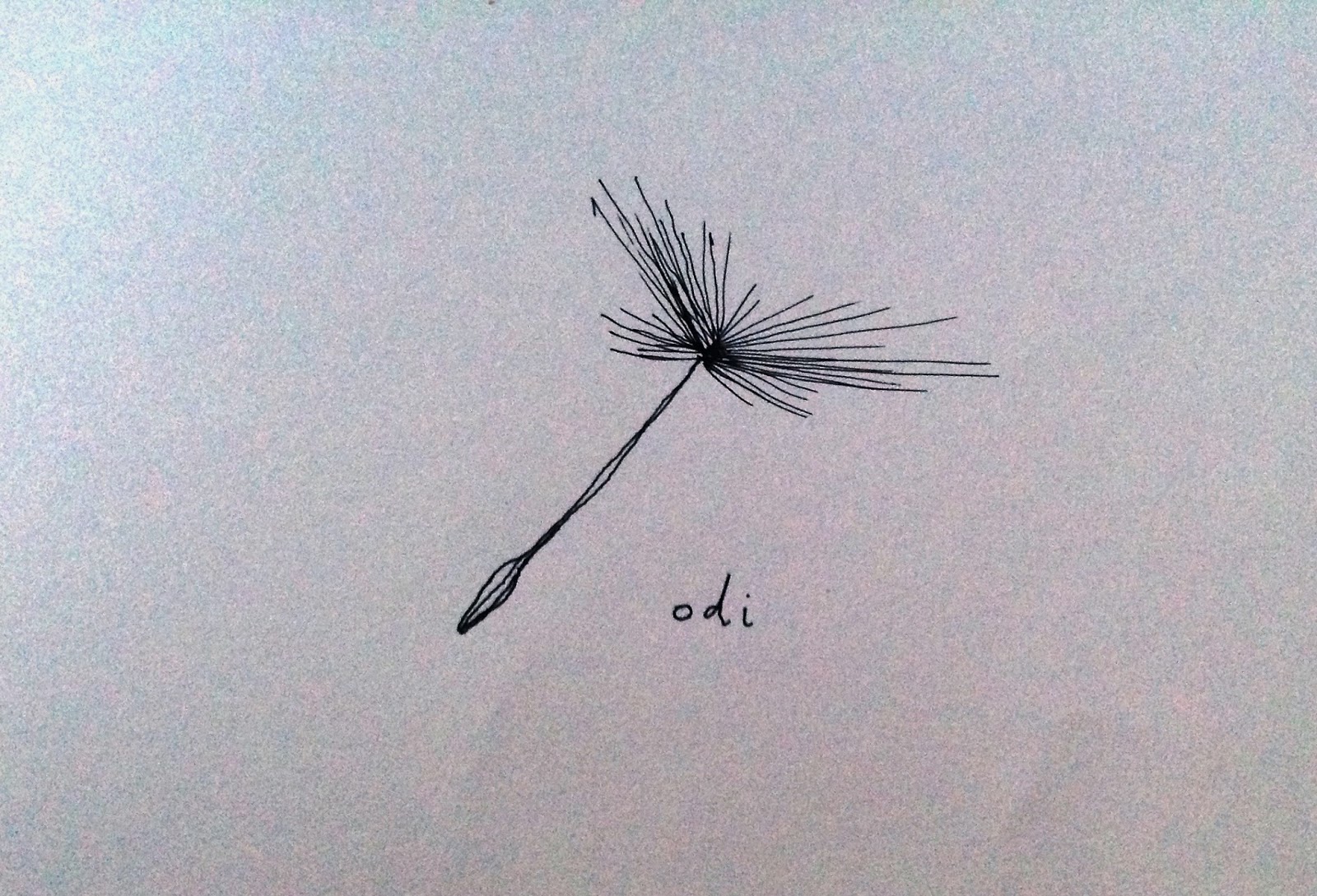
Odi the seed

To my goddaughter Pía, whom I love dearly


Ilustration by Sophie Mason


Odi the seed

Odi was a dandelion seed. She was born in a green field high in the mountains, amongst red poppies and violets. Even though it was cold, she always felt warm, for she spent every day and night curled up with her sisters. Together they formed a warm cotton jumper in the shape of a ball.
She was very happy. She adored her sisters and got on very well with the other inhabitants of the field: with Molly the poppy, Sally the violet, Vince the bumblebee, Lola the dragon fly, Victor the beetle…
Suddenly one night, the wind began to blow ferociously. It sounded like the howling of a wolf under the full moon. It blew, and it blew, stronger and stronger. One by one it took away all of Odi’s sisters until she was left alone. She felt very scared and held onto her mother with all her strength. But the Wind is much more powerful than a tiny little seed, and in the end he snatched her away.
She was very cold and frightened. Until then she had only moved gently, swaying in the soft afternoon breeze, holding onto her sisters. Now she floated weightlessly alone out into the dark.
After the long night, finally the light arrived, painting a beautiful landscape which Odi had never known before. First in grey tones, but then, as the sun showed his smiling golden face in the east, the landscape was flooded with a thousand colours. Our little friend was fascinated; what she saw was so stunning that she forgot to be scared.
She remembered Robin, a friendly and colourful bird who had once rested next to her back in the field. Odi, surprised by that new exciting creature, asked him where he came from.
-From the sky- Robin tweeted.
-But only the sun, the stars, and the moon live in the sky- answered Odi.
-And also the birds, for we were given wings to fly- sang Robin happily.
Then Odi realized that like Robin, she was flying too, and she didn’t even have wings! She didn’t feel alone any more, nor did she feel unprotected or defenseless. She definitely didn’t feel scared, she felt free. This new found feeling made her very happy, happier than she had ever been.
She flew high into the sky, over valleys and mountains, rivers and lakes, deep canyons and soft rolling hills. She saw mountain goats with curvy horns hanging from the naked rocks, galloping horses in green fields, peaceful grazing cows, bleating sheep following their shepherd; foxes, cats, chickens, mice; eagles drawing wide circles flying even higher than her… She also saw all kinds of trees: sharp poplars, magnificent lonely oaks, generous chestnuts, pine trees sewing the air with their needles, naked cork trees, twisted old olive trees, round holm oaks…
One day she reached the sea, and she was astonished by its deep blue colour. It was immense! Much bigger than anything she had ever seen before. It sang, and its voice was similar to that of the wind, but deeper. Its movement reminded her when she used to sway in the breeze, curled up with her sisters, in the green mountain field. For the first time she felt sad, because she missed them. She also felt tired.
The wind, who had grown fond of her after sharing such a long journey, sensed her sadness and said to her in his hissing voice that sounded like a whisper:
-It’sssss tiiime toooo ssseparate ssso long my ffffffriend.
Then he stopped blowing and Odi began to descend. She fell and she fell, until she landed softly on the ground on a green island beyond the sea. Sad and lonely Odi fell asleep, and the earth, always so hungry, swallowed her.
She slept for a long time, and when she finally awoke, she found herself buried in the darkness. She felt scared. She was trapped. But then she remembered that long night in which her journey began, and how when the sun came up, with his smiling golden face, the darkness went away. So our brave little friend started to push against the darkness that covered her to head back to the light. And she pushed, and she pushed, and she pushed…
So much did she push that in the end she sprouted, and her head popped out above the ground. She again felt the warm sunlight in her face and again she breathed the fresh air.
What Odi didn’t know is that she was no longer a seed; she had turned into a beautiful yellow flower.


A.M.B.
October 2015

sábado, 15 de marzo de 2014

II. Unyielding, divine.


DÁMASO ALONSO

II. Unyielding, divine.

How lovely you are, freedom. There is no
match for you. What? Give me torment.
Brighter it shines and in purer firmament
freedom in torment purified.

Must I not scream? Am I gagged?
Come: gag my thoughts if you may.
Scream is not waves vibrating in the wind:
scream is human consciousness being set free.

How lovely you are, freedom. God himself
saw you shine, as he faced the first abyss,
on his chest, one lonely star.

He took in his hand one spark from
the burning volcano. And ignited you in my forehead,
free flame of God, beautiful freedom.


Traducción A.M.B
Marzo de 2014

domingo, 9 de marzo de 2014

The undercurrent of time


The undercurrent of time

As the river flows full
down it’s way to the big blue,
we leave behind all hope and despair
realising it’s just best to be.
For the future is nothing but a handful of sand
and as each grain slips through
it turns into the past
blown away by the wind.
So where lays the now, my love,
so sharp, so thin,
never remaining still?
The now doesn’t yearn,
nor does it hope,
it feels no longing for times that were,
nor does it desire what it will be.
The now, aloof and elusive, awaits us
gracefully balancing amidst all movement,
standing in the fine line of acceptance,
floating weightless down to the endless sea.


A.M.B.
Marzo de 2014

domingo, 12 de enero de 2014

The boy who built sand castles


The boy who built sand castles

         Mathew was born next to the ocean, in a house that stood alone by the beach. Only an old path connected his home to the village, and his garden was made of sand. Behind the house a dense pine forest separated them from the inland. His father was a fisherman, and his mother took care of the house and his education, tutoring him at home, for the school was a long two hour walk away.
He had no siblings, so he spent a lot of time alone, staring out into the sea, so different everyday: sometimes temperamental or even angry, others soft and calm. He especially liked the days when the air was clear and he could walk his eyes along the horizon, riding it in the saddle of a big black horse, looking over the edge of whatever lay beyond. He also loved searching the beach for treasure: shells with spiral shapes that reminded him of waves, colorful stones that stood bright against the pale earthy tones of his surroundings, oddly shaped sticks which turned into shiny swords or big bows, transparent jelly fish which made the world look funny.

And he loved building sand castles.

         He couldn’t remember the first time he’d built one. For him, building sand castles was like walking, or talking. When he was little they were simple, his mother had given him a bucket, and he would just fill it with sand and then turn it upside down. He loved that magical moment after removing the bucket, the round tower would stand upright with a crown of battlements. Then he would build an army with the bits and pieces that he found in the sand. He would imagine big battles between Christians and Moors, which would normally end with a big pinecone crashing the tower. Other times he would place a small colorful shell on top, and give her a beautiful princess name like Lily, or Daisy, or Rose. Riding a tiny stick he would go to her rescue, fighting with dragons and evil sorcerers on the way. He was always victorious. Then, when his mother would call him in to eat dinner, he would forget all about the castle. The next day he would build another one.
         As Mathew got older he began building bigger and bigger sand castles. First he added a moat, and turned twigs into fierce crocodiles. Then one tower wasn’t enough, so he began to build castles with two, three, four, and even thirteen towers. Then he added a portcullis that he would carefully make with pine needles, and drawbridges minutely made with match sticks. After that, towers didn’t seem enough, so he started building them around a big courtyard. Inside he built stables, and a great hall, and even a chapel.
He no longer daydreamed; he was too focused on building the castle itself. There were no more knights in shining armor, nor dragons, princesses, or epic battles. He enjoyed the actual castle too much to think about anything else. His imagination was still vivid, but all he could imagine was bigger and more formidable castles.
         He began to build them further and further away from the water. It would take him days to build one and he didn’t want them to be washed away by the waves. This was very hard work. The beach was wide and he still needed the wet sand to work on, so he had to carry it across the beach. It was heavy. His small feet would sink into the sand, but he didn’t mind. He set to work with a strange determination for such a young boy. However, the moon would get bigger and the tides fuller. Around full moon, no matter how far away from the water line his castle was, it would be washed away by the sea.
         He put a lot of time and effort into his work, and it made him really angry that the sea would just eat it away. Before, he had such a strong connection with the big blue, but now it made him anxious: when it was rough he was afraid for his work; and when it was calm, he found it a cheater, as if it was only pretending to be calm and then, as soon as he turned his back, destroy his castles. He no longer looked at the horizon, nor did he wonder about what lay beyond it.
         Nevertheless he carried on building his castles, and they got bigger and bigger, more and more detailed. By now he was even making the bricks in the walls, and the towers had pointy caps. There were windows and balconies, and his drawbridge could actually draw. But the bigger and more detailed they became, the more work and love he put into them, the harder it was to watch them go. Every time he woke up and found them washed away he was furious. He would scream at the sea, thinking that his yelling would be louder than the roar of the waves. He would cry bitterly, thinking that his tears were saltier than the water of the sea. He felt his anger bigger than the immense ocean that opened wide before his eyes.
        
He stopped building sand castles.

His parents were very worried about him. He showed a sorrow too profound for a boy who hadn’t even hit his teens. At first he prowled around the house, in a thick veil of melancholy. His eyes had lost their spark. After, some weeks he became numb, and no longer had any drive for life. It took a lot of effort from his mother to get him out of bed. He was absent minded in her lessons. While before he had been curious and eager, now he just sat with a blank look in his eyes.
One day, his mother had enough of his apathy and sent him out of the house for a walk. He would have preferred to adventure into the pine forest, but it was a cold winter day, and the sun was low in the sky, so he went to the beach, were he thought he’d be warmer. After a while he decided to sit, but he did so with his back turned to the sea. This, however, was very uncomfortable. The beach, as all beaches do, sloped towards the water. He turned around and was forced to face it again. He looked at it with rage and defiance. Then, suddenly, he saw some little dot come out of the horizon. It moved towards him. At first he thought it must be a ship, but he quickly discarded the idea. It moved differently, and there was something about it that made him extremely curious. After seconds, or minutes, or maybe hours, he couldn’t really tell, he realized that it was a girl. Before he knew it she was standing right in front of him.
She must have been around his age. She stood almost as tall as he was, and had an airy look about her, as if she was always dreaming, or had been born in a dream. Her eyes were blue like the sea where she had come from, and when she said hello it sounded soothing, like the undercurrent of a small wave.
The tide was low but getting fuller. She moved towards the shore, picking up a stick on her way. He couldn’t help but follow her. She began to draw him in the sand, and she worked with the stick as others would with a fine pencil. It was beautiful to watch her work. Her hand moved in circles as she tenderly scarred the sand. He soon realized she was making a portrait of him. He looked angry in it, and in some way, that seemed magical to him. She managed to use the different tones in the sand, and the random stones and shells that were in it, to create light and shadow in his face. Every time she looked up towards him he felt a new, strange, and exciting warmth grow within him. She felt it, and would smile back at him. As her fine lips parted, he felt something opening up inside him. She barely touched the sand with the stick, yet the portrait grew fuller and fuller, strikingly vivid. It was as if she had rearranged the sand, and everything that was in it, with her mind, rather than with the stick.
Then, when she was finished, she looked up at him, and as she did so, a big wave came and washed the portrait away. He was devastated, and all the old rage flourished again, transforming itself into one bitter tear that rolled down his cheek. As the wave drew back, leaving no trace of her work, she seemed to lighten up   a graceful movement, she collected the tear from his cheek with a light stroke of the stick, and it felt like a caress. She began to work again. This time she drew him building one of his castles. He was absorbed, fascinated, enchanted at watching her work. No trace was left in him of the bitterness he’d just felt.
The drawing was alive. It wasn’t precise or realistic, yet it was full of volume and light. It seemed to him that it had a heartbeat. She first drew him, and then the castle he was working on. It appeared as if it was the boy in the sand who was actually building the castle, but that didn’t make any sense, it didn’t matter. Nor did it make any sense that she had floated over the water from the horizon. When it was finished, the drawing was just splendid. The castle was worthy of his best work. She walked near him and put her hand in his. As she looked out to the sea, so did he. They saw a big beautiful wave rolling towards them. It crashed over the drawing, stopping just short of their feet. This time Mathew felt sad for the piece to disappear, but it was a very different type of sadness, it was like a burning beauty that almost hurt. There was no anger in him, and her hand was like an anchor that prevented him from being taken by the storm in his soul.
She went back to work, and this time she drew him looking out to sea. The drawing emanated peaceful serenity. In it he gazed upon the horizon. As she worked, the sea got calmer and calmer. One could not tell if the drawing made the sea tranquil, or if it was the other way around. When she finished, everything went quiet. Time had stopped. She walked next to him again, and very tenderly kissed him on the cheek, in the same place where she had collected his tear. As her lips drew away from him, the sea began to move again. A tremendous wave rolled towards the shore, again stopping just short of his feet. It washed away the drawing. As the wave drew back revealing the smooth sand, soft and untouched, Mathew felt he was taken out to sea with it. He surrendered, he wasn’t fighting, he wasn’t struggling. There was no need for air. He was becoming one with it. Another tear rolled down his cheek.
For some time he stood still, feeling the same connection he’d felt with the sea years before. Again he found himself riding the horizon. He felt in him the movement of the waves. His soul expanded until it became infinite, like the ocean. He felt at peace. He looked around for her, to embrace her, to kiss her, to thank her. But she was gone.

And Mathew began building sand castles again.


A.M.B.
  Noviembre de 2013